Water
How Much Water to Store for an Emergency: A Room-by-Room Plan
One gallon per person per day is the federal baseline, three days minimum and two weeks ideally. Storage location matters as much as quantity.
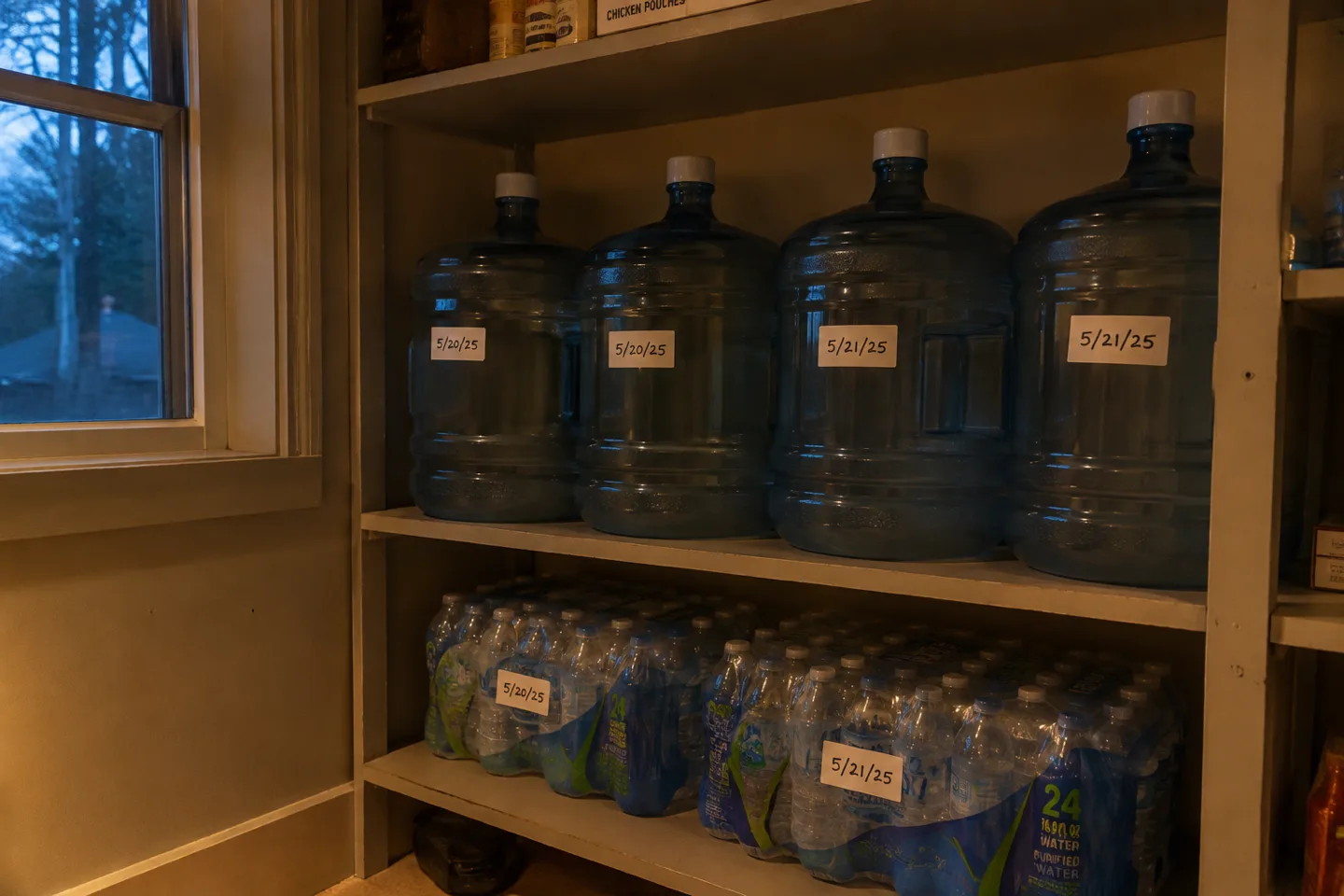
When a disaster cuts off your tap water, the clock starts immediately. Knowing exactly how much water to store, and where to keep it, can be the difference between a manageable inconvenience and a genuine crisis. The good news is that federal agencies, public health organizations, and emergency preparedness experts agree on clear, actionable benchmarks you can put into practice today.
The Baseline Rule: One Gallon Per Person Per Day
The Federal Emergency Management Agency (FEMA) and the American Red Cross both recommend storing at least one gallon of water per person per day. Ready.gov, the official U.S. government emergency preparedness portal, specifies that this baseline should cover a minimum of three days for evacuation scenarios and ideally two weeks for sheltering in place.
That one-gallon figure accounts for roughly half a gallon for drinking and the remainder for basic sanitation such as hand-washing and minimal food preparation. It is a floor, not a ceiling.
When the Baseline Is Not Enough
Not every household member has the same water needs. The CDC notes that the following groups require significantly more water than the standard one-gallon baseline:
- Pregnant women need additional water to support fetal development and to stay properly hydrated, particularly in stressful conditions.
- Nursing mothers require extra fluid to maintain milk supply.
- Children can lose water rapidly through activity and may need more than adults on a per-pound basis.
- People with certain medical conditions, including kidney disease, diabetes, or those on specific medications, may need increased fluid intake as directed by their physician.
- People living in hot climates or working outdoors can lose significantly more water through sweat and may need two to four times the standard amount.
For households with pets, the Red Cross recommends storing an additional one quart of water per small dog or cat per day, scaling up for larger animals.
A Room-by-Room Storage Plan
Storage location matters as much as quantity. Water must be kept away from heat, light, and chemicals. Here is a practical room-by-room breakdown.
Kitchen
The kitchen is the most natural starting point because water stored here is immediately accessible for cooking and drinking. Store commercially sealed water bottles or FEMA-approved food-grade water containers in a cool, dark cabinet or pantry. The Utah State University Extension recommends using containers specifically designed for water storage rather than repurposing milk jugs, which are difficult to clean thoroughly and can harbor bacteria. Aim to keep enough in the kitchen for immediate three-day access, roughly three gallons per person.
Bathroom
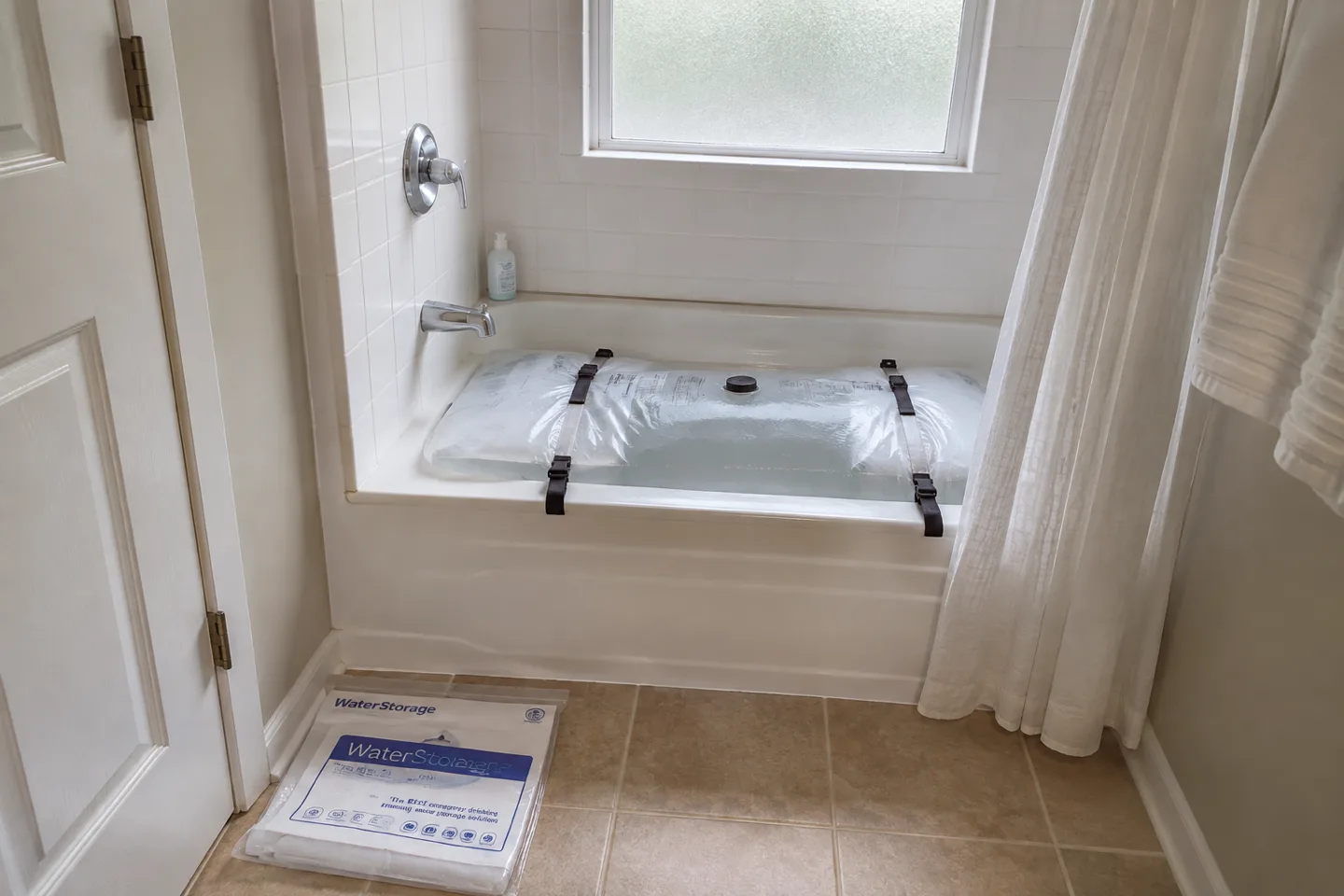
Bathrooms are the most logical place to store water designated for sanitation, toilet flushing, sponge baths, and hand-washing. A standard toilet requires approximately one and a half gallons per flush, so accounting for this need separately keeps your drinking supply intact. Large-capacity water bobs or bathtub bladders, which can hold up to 100 gallons of tap water, can be inflated and filled within minutes of an emergency warning. Store the bladder in an accessible location, under the sink or in a linen closet, so you can deploy it before water service is interrupted.
Garage or Utility Room
For long-term supply beyond three days, a garage or utility room is ideal. Large food-grade water barrels (typically 55 gallons) can store a family's two-week supply in a single container. Keep them on a pallet or wooden platform rather than directly on concrete, which can cause chemicals to leach into the container over time. Rotate stored water every six months to twelve months even if the containers remain sealed, because commercially bottled water can absorb plastic-associated compounds after extended storage.
Bedroom or Closet (Go-Bag Supply)
Every household member should have a personal go-bag containing at least a 72-hour water supply in the form of sealed water pouches or compact water bottles rated for long-term storage. Store the go-bag in a bedroom closet or near an exit so you can grab it quickly if you need to evacuate. Ready.gov recommends keeping go-bags accessible rather than buried under other gear.
How to Store Water Safely
The CDC and the FEMA Are You Ready? guide outline the following standards for safe water storage:
- Use food-grade containers only. Look for containers made from high-density polyethylene (HDPE) with a recycling symbol and the number 2, or containers explicitly labeled food-safe.
- Clean containers before filling. Wash new containers with dish soap and rinse thoroughly, then sanitize with a dilute bleach solution (one teaspoon of unscented liquid chlorine bleach per quart of water), swirl, and drain.
- Fill from a treated municipal source. Tap water from a treated municipal supply is already disinfected and does not require additional treatment before storage.
- Add bleach only if the water source is untreated. If filling from a well or untreated source, add eight drops of unscented liquid chlorine bleach per gallon of water.
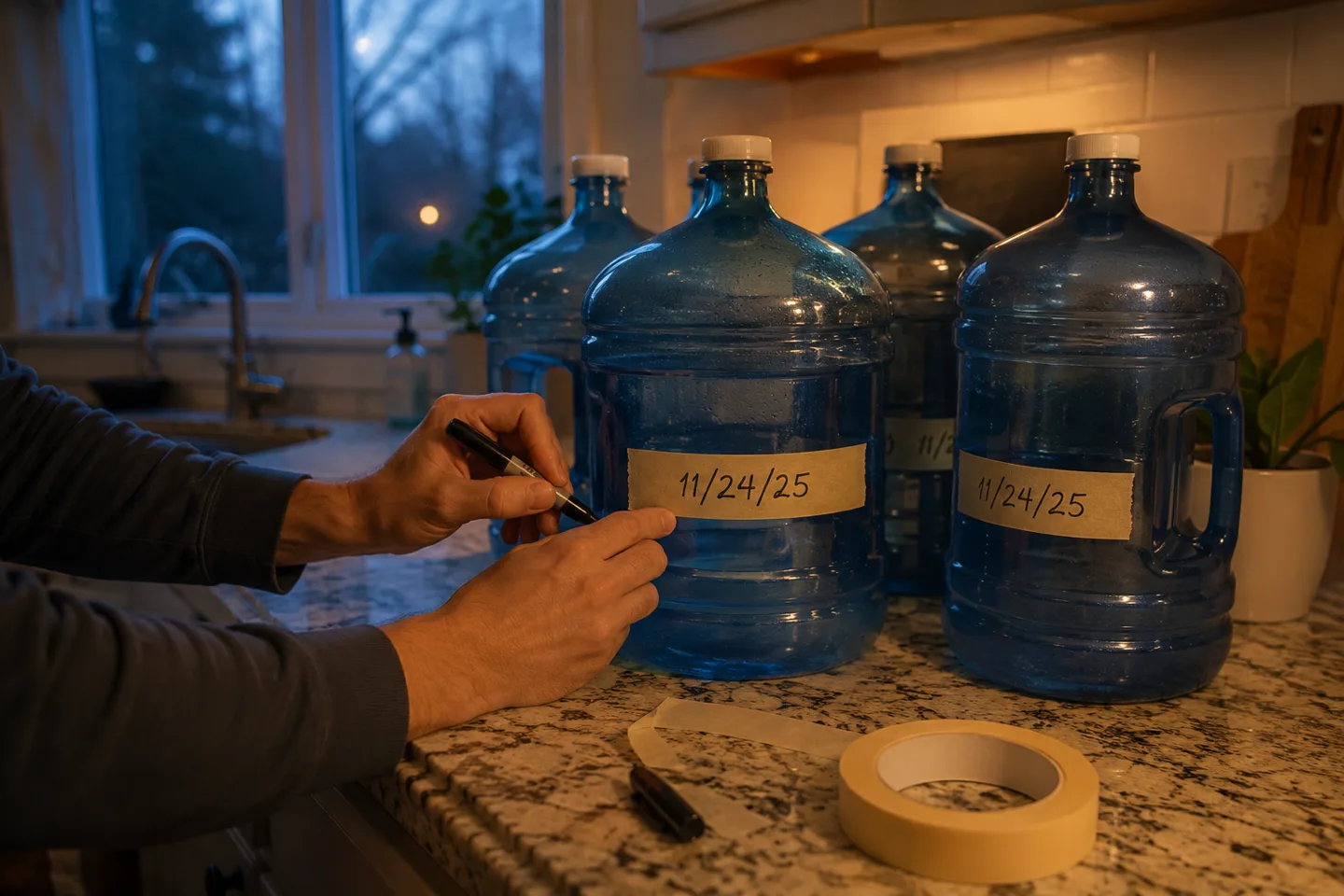
- Seal tightly and label with the fill date. Mark each container with the date it was filled and the source of the water.
- Store in a cool, dark location. Avoid areas next to gasoline, pesticides, or other chemicals, as vapors can penetrate plastic containers.
- Replace or rotate every six to twelve months. Commercially bottled water typically carries a "best by" date for taste and packaging integrity, not for safety, but USU Extension still recommends replacement within that window.
Calculating Your Household Total
Use this quick formula:
Daily need: (Number of people × 1 gallon) + (Number of pets × 0.25 gallons for small pets)
Total for 3-day evacuation kit: Daily need × 3
Total for 2-week shelter-in-place supply: Daily need × 14
For a family of four adults with one medium-sized dog:
- Daily need: 4 gallons (people) + 0.5 gallons (dog) = 4.5 gallons
- 3-day kit: 13.5 gallons
- 2-week supply: 63 gallons
Adjust upward if any household members fall into the higher-need categories described above. The Mayo Clinic notes that adults in temperate climates typically need about 3.7 liters (roughly one gallon) per day for men and 2.7 liters (about 0.7 gallons) per day for women from all combined beverage and food sources, a useful reality check against the flat one-gallon-per-person benchmark.
Water Sources If Your Supply Runs Out
If stored water runs out before services are restored, the CDC recommends the following alternative sources, in order of preference:
- Commercially bottled water (if still available locally).
- Boiled water: Bring water to a rolling boil for at least one minute (three minutes if you are above 6,500 feet elevation) to kill pathogens.
- Chemically treated water: Use unscented liquid chlorine bleach (eight drops per gallon for clear water, sixteen drops per gallon for cloudy water) and wait thirty minutes before drinking.
- Filtered water: A portable filter certified to NSF/ANSI Standard 53 or 58 can remove biological contaminants but will not remove dissolved chemical pollutants.
Never use water from swimming pools, fountains, or radiators for drinking without testing and treating it, as these sources may contain chemicals harmful to human health.
A Note on Shelf Life and Rotation
Commercially sealed water does not expire in the way food does, but packaging can degrade and affect taste. Store-bought water typically carries a two-year best-by date. Water you store yourself in food-grade containers should be refreshed every six months. If stored water smells or tastes off, discard it and refill, but do not rely on taste or smell alone to determine safety, as many chemical and biological contaminants are odorless and flavorless.
Building an emergency water supply does not require a large upfront investment. Starting with a single case of bottled water and a food-grade five-gallon container puts you ahead of the majority of households. Add a layer each month until your household reaches the two-week benchmark, and the task becomes entirely manageable.
Sources
- Ready.gov (FEMA), Water
- American Red Cross, Water and Food in an Emergency
- Centers for Disease Control and Prevention, Creating and Storing an Emergency Water Supply
- Utah State University Extension, Water Storage
- Mayo Clinic, Water: How Much Should You Drink Every Day?
Blackout Ready is not affiliated with, or endorsed by, any agency cited here. Guidance can be updated after we publish; check the source for the current version.
Last reviewed: August 11, 2026